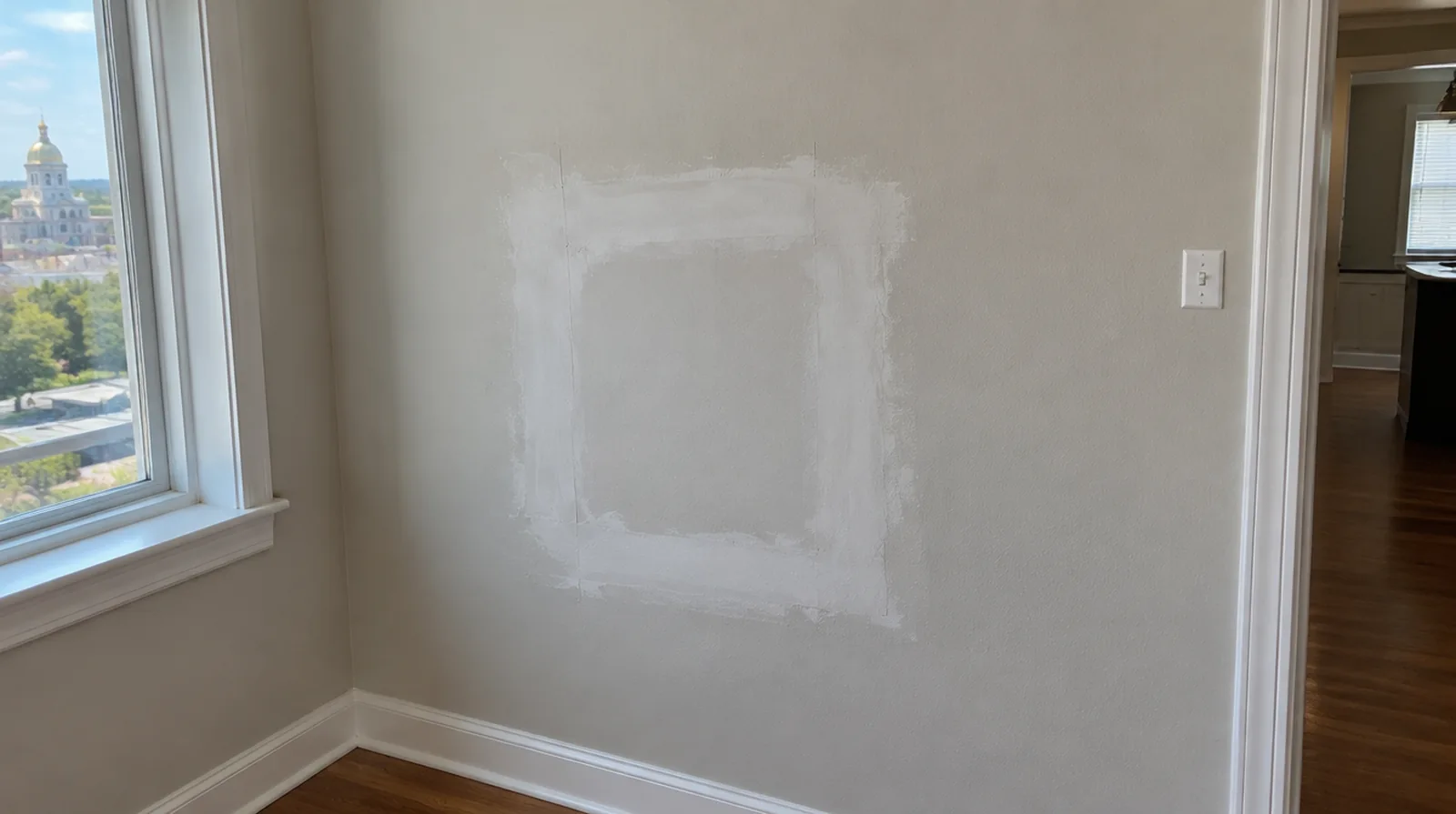
Review with side lighting
A patch that looks flat from the doorway may still show a small hollow under a nearby window. Window light may reveal a contour that ordinary room lighting hides, while paint sheen creates an independent issue. At a repair beside an opening, allow clearance for moving board through the doorway and space to use the finishing tools effectively.
Build thin finishing coats
Several controlled applications are normally easier to flatten than one deep deposit of drywall joint compound. Each layer needs enough drying interval before the next pass can be judged accurately. Where several contractors share the renovation, identify the inspection and handover milestones that determine when each following stage can proceed.
Handle small fastener marks
A bump over a fastener may reflect separation or movement at the panel support. Adding appropriate fastening nearby may be necessary before the damaged spot receives finishing compound. For a project with several trades, agree which inspection or handover point must happen before the next person starts work.
Document recurring movement
A crack that repeatedly reappears might need the cause investigated before more cosmetic work. State any moisture or movement concerns that another professional must resolve ahead of the drywall repair. If the wall surface work belongs to a broader renovation, coordinate its order with flooring, cabinetry and trim rather than scheduling finishing in isolation.
Reinforce panel seams
The connection between old board and a patch needs reinforcing joint treatment. The tape belongs in a compatible bedding coat without trapped air or dry unbonded edges. In a room with little free floor space, identify temporary storage for belongings and establish adequate clearance for the work before delivery.
Set the paint boundary
Even a well blended patch can remain noticeable when touched up with an aged or unavailable paint color. Consider a corner to corner decorative boundary when color or sheen differences would otherwise remain noticeable. If the interior will remain occupied, identify a practical separation between the protected room and the space that still needs daily access.
Protect adjacent surfaces
Small wall repairs can still distribute fine dust through the interior if protection is inadequate. The work plan should identify what needs moving and which room can remain in use. When building management controls access, agree delivery hours and common area protection before committing to a start or finish date.
Feather beyond the opening
Concealing a patch perimeter requires a tapered finishing area wider than the opening itself. A broad blend reduces the ridge that otherwise appears when light travels across the wall surface. Where flooring is staying in place, agree on protective coverings and check that tools and material handling will not damage the visible finish.

Identify the cause
Damage from an impact is not assessed in the same way as a seam that keeps splitting at a door opening. Check whether the wall feels firm and whether the defect has changed since it first appeared. For a wall receiving a decorative covering, provide its preparation requirements early sufficient for the drywall finish to support that product.
Support the replacement
Larger openings need a fitted board patch secured to framing or suitable backing rather than a thick mound of compound. Use a replacement that aligns with the original panel face before attempting to blend the joints. When the decorative coating has been selected, tell the finisher its intended sheen and color while the substrate preparation standard is still being agreed.
Project context in Macon-Bibb
For a Macon-Bibb interior project, a hallway with several door returns is a useful example of why square footage alone does not describe the labor. Where removal is justified, ask how the edge will be supported and where sound material begins.
Scope questions before finishing
When comparing competing estimates, make sure their protection, surface finish and disposal allowances describe equivalent work before comparing the final prices.
If access passes through a shared space, arrange protection and a delivery route that do not unnecessarily obstruct other occupants.
For a surface that will receive wall covering, share the product requirements early so the finishing stage supports the planned decorative treatment.
In a room with little free floor space, identify temporary storage for belongings and establish adequate clearance for the work before delivery.
If materials must cross common building areas, plan the protection and access route so other occupants are not needlessly obstructed by deliveries.
At an edge beside built in furniture, state whether the obstruction will be removed or whether finishing stops at the section that can be reached.
For a planned new wall mounted fixture, resolve its backing requirements while the cavity remains open instead of cutting into completed drywall later.
When reviewing the finished work, use the agreed lighting and natural room viewpoints so the assessment reflects the intended use of the space.
For a wall receiving a decorative covering, provide its preparation requirements early adequate for the drywall finish to support that product.
If the ceiling or wall includes fittings, identify the person responsible for removing and reinstalling each item before the work begins.
If the existing finish is unusual, keep a small reference sample or a close photograph to support the discussion about blending and restoration.
If the surface condition is uncertain, allow for an assessment that can distinguish stable material from layers that should never be covered.
Explore the Macon-Bibb drywall overview for related options, or read the project planning information before arranging the next stage.
More planning details for Macon-Bibb
Each edge, frame and change of plane affects protection and finishing access. Measure the separate surfaces and explain which doors need to remain usable while compound dries. Humid summer conditions can influence the interval between coats, while cooler periods may require attention to the room temperature.